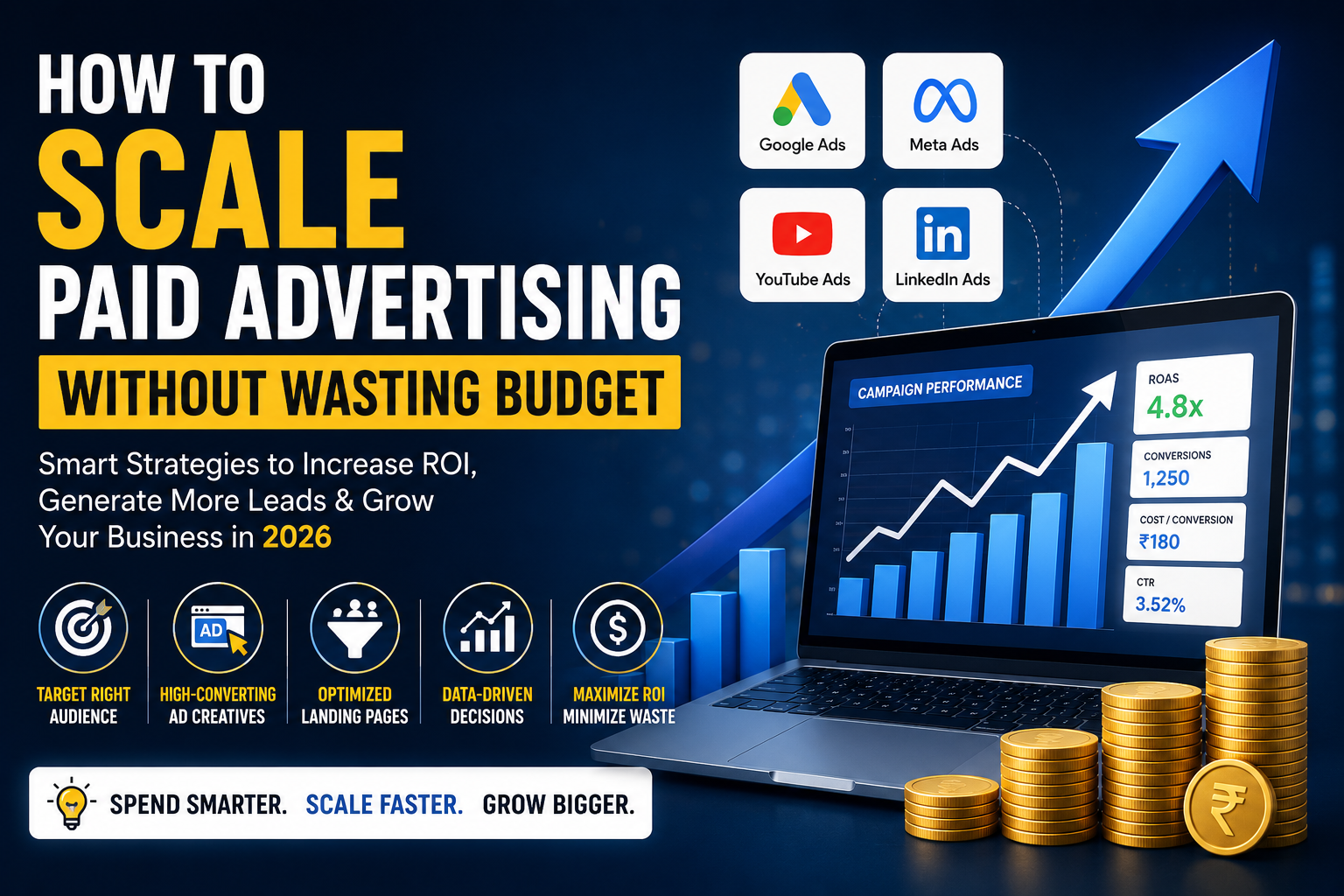
Paid advertising has become one of the fastest ways for businesses to generate leads, increase website traffic, and drive sales. Platforms like Google Ads, Meta Ads, LinkedIn Ads, and YouTube Ads offer businesses the opportunity to reach highly targeted audiences and achieve measurable results. However, simply increasing your advertising budget doesn’t always translate into better performance.
Many businesses fall into the trap of scaling their campaigns too quickly, resulting in higher costs, lower conversion rates, and wasted ad spend. Instead of generating more qualified leads, they end up paying more for clicks that don’t convert. This often happens due to poor audience targeting, ineffective creatives, weak landing pages, or a lack of data-driven optimization.
Scaling paid advertising successfully requires a strategic approach. It’s about identifying what already works, optimizing every stage of the customer journey, and increasing your budget in a controlled manner while maintaining profitability. The goal isn’t just to spend more—it’s to generate more revenue with every advertising dollar.
In this guide, you’ll learn how to scale your paid advertising campaigns without wasting your budget. We’ll explore the key signs that indicate your campaigns are ready to scale, the most common reasons businesses overspend on ads, and proven strategies to maximize your return on investment in 2026.
What Does Scaling Paid Advertising Mean?
Scaling paid advertising is the process of increasing your ad spend to generate more leads, sales, or conversions while maintaining or improving your return on investment (ROI). The objective is not simply to spend a larger budget but to expand successful campaigns in a way that keeps customer acquisition costs under control.
Many businesses believe that doubling their ad budget will automatically double their results. In reality, scaling requires careful planning, continuous optimization, and close monitoring of campaign performance. Without the right strategy, increasing your budget too quickly can lead to higher costs per click, lower conversion rates, and a decline in overall campaign efficiency.
Effective scaling involves improving every part of your advertising funnel—from audience targeting and ad creatives to landing pages and conversion tracking. When each component is optimized, you can confidently increase your budget while maintaining strong performance.
Why Businesses Waste Their Paid Advertising Budget
One of the biggest challenges in paid advertising is inefficient spending. Many businesses invest significant amounts in digital advertising but fail to achieve the expected return because of avoidable mistakes.
Understanding these common issues is the first step toward building campaigns that scale profitably.
Poor Audience Targeting
Even the most compelling advertisement will fail if it reaches the wrong audience. Broad targeting often results in irrelevant clicks that consume your budget without generating qualified leads.
Successful campaigns focus on audiences based on demographics, interests, online behavior, purchase intent, and previous interactions with your brand. The more accurately you define your audience, the better your campaign performance.
Scaling Too Quickly
Increasing your daily budget dramatically can disrupt the optimization process used by advertising platforms like Google Ads and Meta Ads. Their algorithms need time to adjust and learn from user behavior.
Instead of doubling your budget overnight, scale gradually in small increments while monitoring key performance indicators. This allows the platform to continue optimizing your campaign without causing unnecessary fluctuations.
Weak Landing Pages
Driving traffic to a poorly designed landing page is one of the fastest ways to waste advertising spend. Even if your ads generate clicks, visitors are unlikely to convert if the landing page is slow, confusing, or lacks a clear call-to-action.
An effective landing page should:
- Load quickly on all devices.
- Match the message in your advertisement.
- Present a clear value proposition.
- Include a strong call-to-action.
- Build trust with testimonials, reviews, or certifications.
- Minimize distractions that prevent conversions.
Ignoring Conversion Tracking
Without accurate conversion tracking, it’s impossible to know which campaigns are generating results. Many businesses focus on metrics such as impressions and clicks without measuring actual leads or sales.
Implementing tools like Google Analytics 4, Google Tag Manager, Meta Pixel, and conversion tracking allows you to understand which campaigns deliver the highest return on investment and where improvements are needed.
Poor Ad Creatives
Your advertisement is often the first interaction a customer has with your business. If the creative fails to capture attention or communicate value, potential customers will scroll past without engaging.
High-performing ads typically include:
- A compelling headline.
- Clear messaging.
- High-quality visuals or videos.
- A strong call-to-action.
- Benefits rather than just features.
Regularly testing multiple ad variations helps identify the creatives that resonate best with your audience.
Not Testing Campaigns
Successful advertisers rarely rely on a single advertisement or audience. Instead, they continuously experiment with different headlines, images, videos, audiences, and landing pages.
A/B testing allows businesses to compare campaign elements and make data-driven decisions rather than relying on assumptions.
Signs Your Campaign Is Ready to Scale
Not every campaign should be scaled immediately. Before increasing your advertising budget, it’s important to ensure your current campaigns are delivering consistent results.
Here are some indicators that your campaigns are ready for growth:
Consistent Return on Ad Spend (ROAS)
If your campaigns have maintained a healthy return on ad spend over several weeks, it’s a strong indication that your strategy is working. Consistency is more important than short-term spikes in performance.
Stable Cost Per Acquisition (CPA)
Your cost per acquisition should remain within a profitable range before increasing your budget. If CPA is already rising, scaling too early may reduce profitability.
High Conversion Rate
Campaigns with strong conversion rates demonstrate that your targeting, advertisements, and landing pages are aligned effectively. Scaling these campaigns increases the likelihood of maintaining positive results.
Sufficient Conversion Data
Advertising platforms rely on data to optimize campaigns. If your campaign has already generated a healthy number of conversions, the algorithm has enough information to identify high-quality prospects.
Positive Customer Feedback
Satisfied customers, positive reviews, and repeat purchases indicate that your product or service delivers genuine value. Scaling campaigns for a business with strong customer satisfaction often leads to sustainable growth.
Set Clear Goals Before Scaling
One of the biggest mistakes businesses make is increasing their advertising budget without defining clear objectives.
Before scaling, determine what success looks like.
Your goals might include:
- Increasing qualified leads by 30%.
- Reducing cost per lead.
- Growing online sales.
- Expanding into new markets.
- Improving return on ad spend.
- Increasing brand awareness.
Each objective requires a different campaign strategy and success metrics.
Focus on Profitability, Not Just Growth
Scaling should always be measured by profitability rather than spending.
For example, increasing your monthly advertising budget from ₹50,000 to ₹2,00,000 might generate more leads, but if your cost per acquisition doubles, your overall profitability may decline.
Instead of asking:
“How can I spend more?”
Ask:
“How can I generate more profitable conversions?”
Businesses that prioritize efficiency over spending typically achieve stronger long-term growth.
Conclusion
As digital advertising platforms continue to evolve in 2026, businesses that adopt a strategic, performance-driven approach will outperform competitors who rely on trial and error. Whether you’re running Google Ads, Meta Ads, LinkedIn Ads, or multi-channel campaigns, continuous optimization and data analysis are the keys to scaling successfully.
At Leadswallah, we specialize in creating high-performing paid advertising campaigns that maximize ROI and deliver measurable business growth. From audience research and campaign setup to conversion tracking, creative optimization, and budget management, our experts help businesses scale confidently without wasting valuable ad spend.
Ready to grow your business with smarter paid advertising? Partner with Leadswallah and let our performance marketing experts build, optimize, and scale campaigns that generate high-quality leads, increase conversions, and maximize your return on investment.