
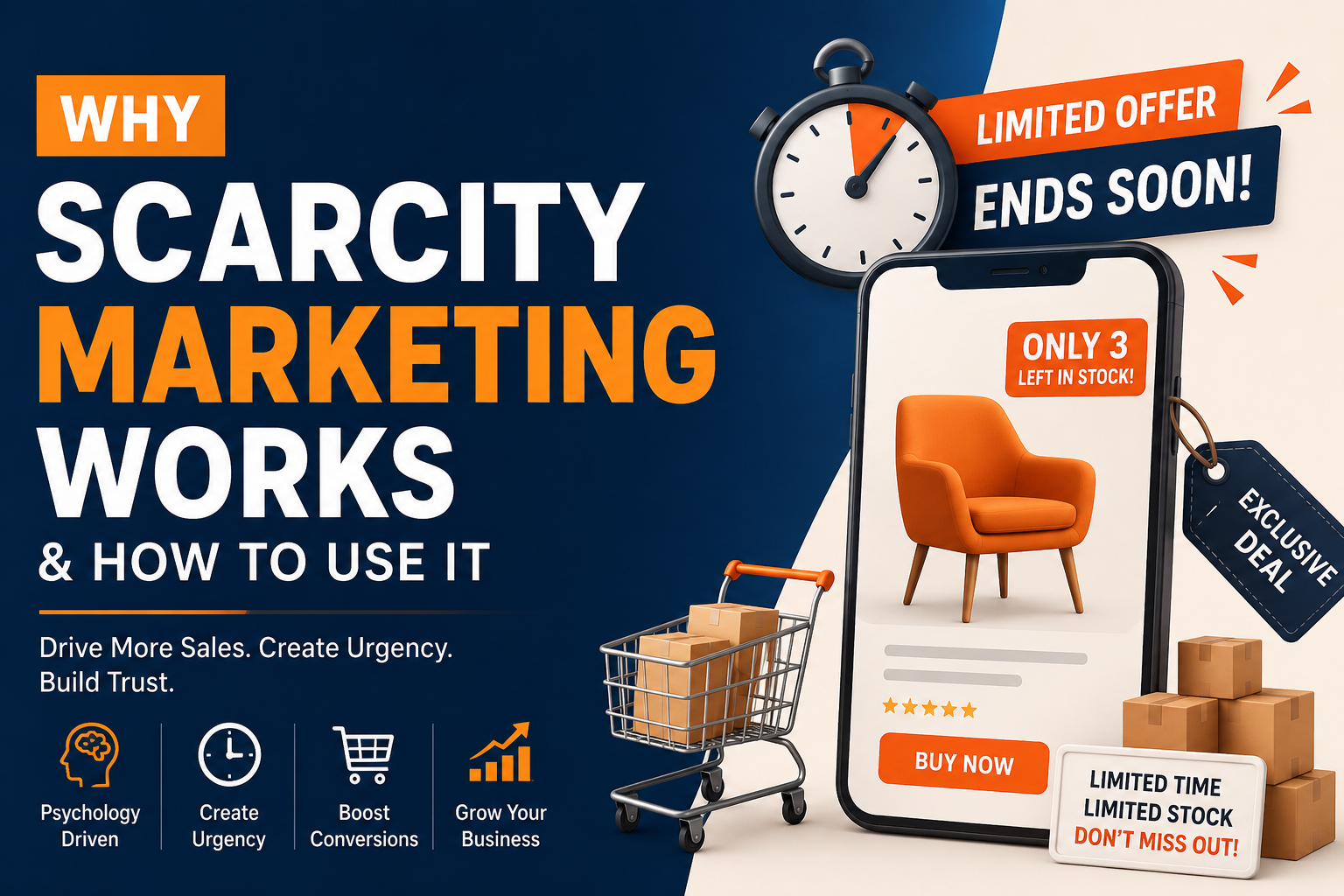
In today’s highly competitive digital marketplace, grabbing your customers’ attention is only half the battle. The real challenge is motivating them to take action before they lose interest or move to a competitor. This is where scarcity marketing becomes one of the most effective marketing strategies for businesses of all sizes.
Scarcity marketing is more than adding phrases like “Limited Time Offer” or “Only a Few Items Left.” It’s a psychology-driven approach that encourages customers to make faster purchasing decisions by highlighting limited availability, exclusive access, or time-sensitive opportunities. When used ethically, scarcity creates excitement, increases perceived value, and significantly improves conversion rates.
From global brands like Apple and Amazon to local startups and eCommerce businesses, scarcity marketing has become a proven strategy for boosting sales without relying heavily on discounts.
In this guide, we’ll explore how scarcity marketing works, why it influences customer behavior, different types of scarcity techniques, practical implementation strategies, real-world examples, and best practices that businesses can use to increase conversions while maintaining customer trust.
What is Scarcity Marketing?
Scarcity marketing is a marketing strategy that encourages customers to act quickly by limiting the availability of a product, service, offer, or opportunity. Instead of convincing customers that a product is better than competitors, scarcity marketing increases its perceived value simply by making it less available.
The principle behind scarcity marketing is simple:
People naturally place higher value on things that are difficult to obtain.
When customers believe they may miss an opportunity, they are much more likely to purchase immediately instead of postponing the decision.
Common examples include:
- Only 5 products left in stock
- Offer expires tonight
- Early bird registration closes in 24 hours
- Exclusive access for members only
- Limited edition collection
- First 100 customers receive a free bonus
Notice that the product itself doesn’t change. The urgency comes from its availability, which creates stronger buying intent.
The Psychology Behind Scarcity Marketing
Scarcity marketing works because it aligns with several well-established psychological principles that influence consumer decision-making.
Instead of relying solely on product features or pricing, scarcity appeals directly to how people naturally respond when opportunities become limited.
Fear of Missing Out (FOMO)
One of the biggest drivers behind scarcity marketing is the Fear of Missing Out, commonly known as FOMO.
When customers believe an opportunity might disappear, they become more motivated to act immediately. Rather than risking regret later, they prefer to secure the offer while it’s still available.
For example, an online course that announces “Registration closes tonight” often receives a surge of enrollments during the final few hours because people don’t want to lose the opportunity.
Limited Availability Creates Higher Perceived Value
Consumers often associate limited availability with higher quality or greater demand.
When a product is available everywhere at all times, it appears ordinary.
However, when the same product becomes difficult to obtain, customers begin to see it as more valuable.
Luxury brands frequently use this strategy by producing limited collections or seasonal releases instead of keeping unlimited inventory.
Scarcity Reduces Decision Delays
Many customers delay purchasing because they believe they can always buy later.
Scarcity removes this comfort.
When buyers know an offer has a deadline or limited stock, they spend less time comparing alternatives and make decisions much faster.
This is especially important for online businesses where customers can leave your website within seconds.
People Hate Losing More Than They Enjoy Winning
Behavioral economists have found that people experience the pain of losing more intensely than the satisfaction of gaining something of equal value.
This principle, known as loss aversion, makes scarcity highly effective.
For example, customers often respond more strongly to:
“Only 2 seats remaining”
than
“Seats available now”
The possibility of losing an opportunity creates a stronger emotional response than simply gaining a benefit.
Why Scarcity Marketing Matters in 2026
Digital advertising has become more competitive than ever.
Consumers see thousands of advertisements every day across search engines, social media platforms, websites, emails, and mobile applications. As a result, attention spans continue to shrink while customer expectations continue to grow.
Businesses can no longer rely solely on attractive designs or discounted pricing.
They need marketing strategies that encourage immediate action.
Scarcity marketing helps businesses:
- Increase conversion rates
- Shorten buying cycles
- Improve campaign performance
- Reduce abandoned carts
- Increase average order values
- Generate excitement around new launches
- Create exclusivity around products and services
Whether you’re running an eCommerce store, a service-based business, an online course, or a SaaS company, scarcity marketing can significantly improve marketing performance when implemented correctly.
Why Businesses Should Use Scarcity Marketing
Many businesses assume they need massive advertising budgets to increase sales.
In reality, improving customer decision-making often delivers better results than simply increasing traffic.
Scarcity marketing helps businesses achieve exactly that.
Some of its biggest advantages include:
Higher Conversion Rates
Urgency encourages customers to purchase before the opportunity disappears, increasing the percentage of visitors who become paying customers.
Faster Sales
Instead of waiting days or weeks before making a purchase, customers act immediately, improving overall sales velocity.
Better Return on Advertising Spend
If more website visitors convert into customers, businesses earn more revenue from the same advertising budget.
Increased Product Value
Limited availability often makes products appear more desirable, allowing businesses to maintain healthy profit margins without relying heavily on discounts.
Stronger Customer Engagement
Scarcity campaigns naturally generate excitement across email marketing, social media, paid advertising, and landing pages, resulting in higher engagement rates.
Common Examples of Scarcity Marketing
Scarcity marketing can be applied in almost every industry.
Some common examples include:
- “Only 10 seats remaining” for webinars and workshops.
- “Flash Sale Ends at Midnight” for eCommerce stores.
- “Limited Edition Collection” for fashion brands.
- “Exclusive Access for Premium Members” for subscription businesses.
- “First 50 Customers Receive a Free Gift” for product launches.
- “Only Available This Weekend” for seasonal promotions.
- “Last Chance Before Price Increase” for online courses or consulting services.
Each example encourages immediate action without necessarily reducing the product’s value.
Conclusion
Scarcity marketing is more than just a sales tactic—it’s a strategic approach that leverages consumer psychology to encourage timely decision-making. When used authentically and ethically, it helps businesses increase conversions, boost customer engagement, and create a sense of exclusivity without relying heavily on discounts. Whether you’re launching a new product, promoting a limited-time offer, or driving registrations for an event, scarcity can make your campaigns more impactful and profitable.
However, the key to successful scarcity marketing lies in honesty and transparency. False urgency or misleading claims may generate short-term sales, but they can damage your brand’s credibility in the long run. By creating genuine limitations, communicating them clearly, and delivering real value, you can build trust while motivating customers to act.
At Leadswallah, we help businesses develop data-driven digital marketing strategies that not only attract the right audience but also convert them into loyal customers. From high-converting landing pages and performance marketing campaigns to conversion rate optimization and lead generation, our team creates marketing solutions that deliver measurable business growth.
If you’re ready to improve your conversions and grow your business with smart, results-focused marketing strategies, Leadswallah is here to help. Contact us today and discover how we can turn more visitors into valuable customers.