
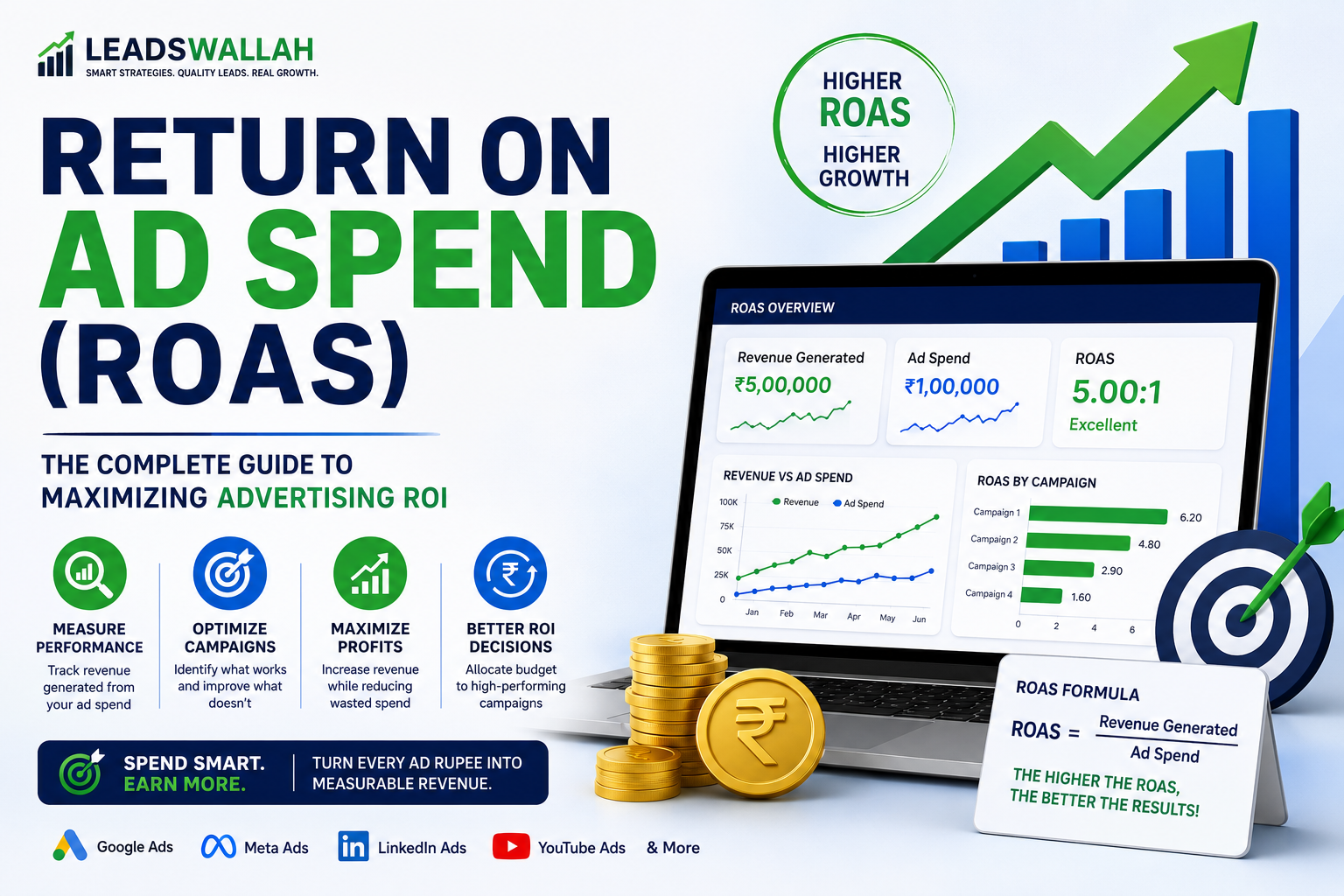
Running digital advertising campaigns without measuring their performance is like driving without a destination. While platforms such as Google Ads, Meta Ads, LinkedIn Ads, and YouTube Ads make it easy to reach millions of potential customers, simply spending money on advertising doesn’t guarantee business growth. The real measure of success lies in understanding how much revenue your advertising generates compared to how much you spend.
This is where Return on Ad Spend (ROAS) becomes one of the most important metrics in digital marketing. ROAS helps businesses evaluate the effectiveness of their advertising campaigns by showing how much revenue is generated for every rupee or dollar spent on ads. Whether you’re a startup with a limited budget or an established business managing large-scale campaigns, monitoring ROAS allows you to make smarter marketing decisions, optimize campaign performance, and maximize profitability.
A strong ROAS indicates that your advertising campaigns are generating profitable results, while a low ROAS signals the need for improvements in targeting, ad creatives, landing pages, or campaign strategy. Rather than relying on assumptions, businesses can use ROAS to identify high-performing campaigns, allocate budgets more effectively, and achieve sustainable growth.
In this guide, you’ll learn what ROAS is, how to calculate it, why it matters, the difference between ROAS and ROI, what constitutes a good ROAS, and the key factors that influence advertising performance in 2026.
What Is Return on Ad Spend (ROAS)?

Return on Ad Spend (ROAS) is a marketing metric that measures the revenue generated for every amount spent on advertising. It helps businesses determine whether their paid advertising campaigns are profitable and provides valuable insights into campaign performance.
Unlike vanity metrics such as impressions, likes, or clicks, ROAS focuses on what truly matters—revenue. It answers a simple but critical question:
“For every ₹1 spent on advertising, how much revenue does the business earn?”
For example, if a company spends ₹20,000 on a Google Ads campaign and generates ₹1,00,000 in sales, the ROAS is 5:1. This means the business earns ₹5 in revenue for every ₹1 spent on advertising.
ROAS is widely used across digital advertising platforms, including:
- Google Ads
- Meta Ads (Facebook & Instagram)
- LinkedIn Ads
- Microsoft Ads
- YouTube Ads
- Amazon Ads
- E-commerce advertising platforms
Because it directly connects advertising spend with business revenue, ROAS is considered one of the most reliable indicators of campaign success.
Why ROAS Matters
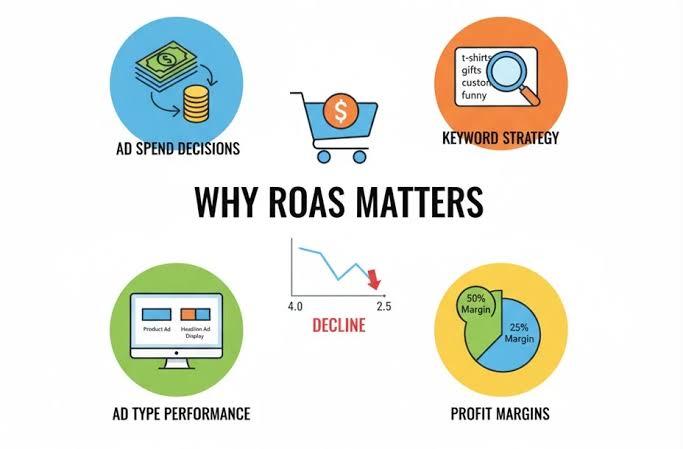
Many businesses judge advertising performance by looking at clicks, impressions, or website traffic. While these metrics provide useful information, they don’t reveal whether advertising is actually generating revenue.
ROAS shifts the focus from activity to profitability.
Tracking ROAS helps businesses:
Measure Advertising Effectiveness
ROAS provides a clear picture of how well each advertising campaign contributes to business revenue. Instead of guessing which campaigns perform best, businesses can rely on measurable data.
Optimize Marketing Budgets
Not all campaigns deliver equal results.
ROAS allows marketers to identify high-performing campaigns and allocate more budget to them while reducing spending on underperforming ads.
Improve Business Profitability
Increasing revenue alone doesn’t guarantee profitability.
ROAS helps businesses understand whether their advertising costs are justified by the revenue generated.
Support Better Decision-Making
Marketing decisions become easier when backed by reliable performance data.
Businesses can confidently:
- Increase budgets on profitable campaigns.
- Pause ineffective advertisements.
- Test new audiences.
- Improve landing pages.
- Refine advertising creatives.
Track Growth Over Time
Monitoring ROAS consistently allows businesses to measure improvements in campaign performance and evaluate the long-term effectiveness of their marketing strategies.
ROAS vs ROI: What’s the Difference?
Although Return on Ad Spend (ROAS) and Return on Investment (ROI) are closely related, they measure different aspects of business performance.
ROAS
ROAS focuses only on advertising performance.
It compares advertising costs with the revenue generated directly from those advertisements.
Formula:
ROAS = Revenue Generated ÷ Advertising Cost
ROAS answers:
“Did this advertising campaign generate enough revenue?”
ROI
ROI measures the overall profitability of an investment.
Unlike ROAS, ROI considers all business expenses, including:
- Advertising costs
- Product costs
- Employee salaries
- Software subscriptions
- Shipping
- Operational expenses
Formula:
ROI = (Net Profit ÷ Total Investment) × 100
ROI answers:
“Was this business investment profitable overall?”
Example
Suppose a business spends:
- ₹25,000 on Google Ads
- Generates ₹1,50,000 in sales
ROAS
₹1,50,000 ÷ ₹25,000 = 6
ROAS = 6:1
However, after deducting product costs, salaries, shipping, and other operational expenses, the actual profit may be much lower.
This is why businesses should monitor both ROAS and ROI.
ROAS evaluates advertising efficiency, while ROI measures overall business profitability.
How to Calculate ROAS
Calculating ROAS is straightforward.
Formula
ROAS = Revenue Generated from Ads ÷ Advertising Spend
Example 1
Advertising Spend:
₹10,000
Revenue Generated:
₹50,000
ROAS:
₹50,000 ÷ ₹10,000 = 5
Result:
For every ₹1 spent on advertising, the business generated ₹5 in revenue.
Example 2
Advertising Spend:
₹1,00,000
Revenue Generated:
₹8,00,000
ROAS:
₹8,00,000 ÷ ₹1,00,000 = 8
Result:
Every ₹1 invested in advertising generated ₹8 in revenue.
Example 3
Advertising Spend:
₹50,000
Revenue Generated:
₹75,000
ROAS:
₹75,000 ÷ ₹50,000 = 1.5
This campaign may generate revenue, but depending on business costs, it may still be unprofitable.
What Is a Good ROAS?
There’s no universal benchmark because every industry has different profit margins and customer acquisition costs.
However, these general guidelines can help:
| ROAS | Performance |
|---|---|
| Below 2:1 | Poor – Campaign likely needs optimization |
| 2:1 to 3:1 | Average – Sustainable for some businesses |
| 4:1 | Good – Healthy return for many industries |
| 5:1 to 8:1 | Excellent – Strong campaign performance |
| Above 10:1 | Exceptional – Highly optimized campaigns |
For example:
- E-commerce businesses often aim for a ROAS of 4:1 or higher.
- Service-based businesses may be profitable with a lower ROAS because their profit margins are typically higher.
- B2B companies might accept a lower initial ROAS if the lifetime value of a customer is substantial.
Instead of chasing an arbitrary number, determine the ROAS that aligns with your business model, costs, and profitability goals.
Factors That Influence ROAS
Several factors determine whether your advertising campaigns achieve a strong return on ad spend.
These include:
- Audience targeting accuracy
- Ad relevance and creative quality
- Landing page experience
- Website loading speed
- Product pricing
- Offer quality
- Conversion tracking accuracy
- Campaign optimization
- Keyword selection
- Bid strategy
- Customer journey
- Seasonal demand
Improving these elements often leads to significant increases in ROAS without necessarily increasing advertising budgets.
Common Mistakes That Lower ROAS
Businesses often struggle to maximize their advertising returns because of avoidable mistakes.
Some of the most common include:
- Targeting audiences that are too broad.
- Sending traffic to poorly optimized landing pages.
- Ignoring conversion tracking.
- Failing to test multiple ad creatives.
- Increasing budgets too quickly.
- Using weak or unclear calls-to-action.
- Not optimizing campaigns regularly.
- Measuring success only by clicks instead of conversions.
Avoiding these mistakes can dramatically improve campaign performance and advertising profitability.
Conclusion
Return on Ad Spend (ROAS) is one of the most valuable metrics for measuring the success of your digital advertising campaigns. Rather than focusing solely on clicks, impressions, or website traffic, ROAS helps you understand how effectively your advertising budget translates into actual revenue. By calculating and monitoring ROAS regularly, businesses can identify high-performing campaigns, optimize underperforming ones, and make informed decisions that maximize profitability.
However, achieving a strong ROAS requires more than simply increasing your advertising budget. Success depends on targeting the right audience, creating compelling ad creatives, optimizing landing pages, tracking conversions accurately, and continuously refining your campaigns based on performance data. Every improvement in your advertising strategy contributes to better returns and more efficient use of your marketing budget.
At Leadswallah, we help businesses maximize their advertising ROI through data-driven performance marketing strategies. From Google Ads and Meta Ads management to conversion tracking, landing page optimization, audience targeting, and campaign optimization, our team focuses on delivering measurable results that help businesses grow sustainably.
Ready to improve your advertising performance and achieve a higher ROAS? Partner with Leadswallah to create high-converting campaigns that generate more qualified leads, increase revenue, and maximize every marketing investment.